Best Squirrel Proof Bird Feeder: 2026 Top Picks
 By perchandseeds.com Editorial Team · Updated October 6, 2026
How we research: this guide is based on manufacturer specifications, published data and verified customer feedback. Products are not personally tested unless marked “Tested by us”. Our process.
We may earn a commission when you buy through links on this site, at no extra cost to you. As an Amazon Associate I earn from qualifying purchases.
If you want the best squirrel proof bird feeder for a typical U.S. backyard, a weight-activated tube feeder is usually the safest bet—especially the Brome Squirrel Buster® Plus. It gives small songbirds access while shutting down when a squirrel lands on it, and it is the strongest all-around choice in most yards. See more bird feeder basics if you are still deciding between hanging, pole, or platform setups.
That said, no feeder is magic. The real winners combine the right mechanism with open placement, the right seed, and regular cleaning. If you are building a fuller backyard setup, birding guides and bird baths and birdhouses can help you support birds beyond just the feeder.
Below are the best current options based on manufacturer specs and verified customer-feedback patterns, with the trade-offs that matter most for squirrel resistance.
Quick picks
Comparison table
| Model | Best for | Key specs | Watch-outs | Check price |
|---|---|---|---|---|
| Brome Squirrel Buster® Plus | Maximum squirrel resistance in a tube feeder | 3 qt / 5.1 lb; weight-activated shroud; Cardinal Ring System | Needs clear open space to work as intended | Amazon |
| Perky-Pet® Squirrel-Be-Gone® Max Bird Feeder with Flexports® - 4 Lb (Model 334-1SR) | Mixed-seed yards | 4 lb; 4 stations; Seed Shield; Sure-Lock cap | Some buyers report lid or port fit issues | Amazon |
| Brome Squirrel Solution200 Squirrel-proof Bird Feeder w/6 Feeding Ports, 3.4-pound Seed Capacity, Free Seed Funnel | Six-port feeding with squirrel resistance | 6 feeding ports; 3.4-pound seed capacity; free seed funnel; weight-activated shroud | Works best with sunflower, safflower, and/or dried mealworms | Amazon |
| Roamwild PestOff® Squirrel Proof Bird Feeder 2.0 | Low-fuss setup | 4 lb; two-port tube; springs at each port; rain guard | Only two ports, so traffic can bottleneck | Amazon |
Our picks in detail
Brome Squirrel Buster® Plus
Best for: Maximum squirrel resistance in a tube feeder
Best overall for most backyards: a true weight-activated tube feeder that still lets small songbirds feed comfortably.
Brome lists a 3-quart / 5.1 lb capacity, the patented Cardinal Ring System, chew-proof and UV-resistant parts, and detachable components for cleaning.
Sold direct by Brome, not Amazon US; it works best with the maker's clearance guidance because nearby branches or rails can defeat any feeder.
- Capacity
- 3 qt / 5.1 lb
- Mechanism
- Weight-activated shroud
- Feed ports
- Patented Cardinal Ring System
- Size
- 6.5 in x 6.5 in x 23.75 in body; 28 in with hanger
- Materials
- Chew-proof, UV-resistant parts
Pros
- Excellent squirrel deterrence when placed correctly
- Welcomes small songbirds comfortably
- Detachable parts make cleaning simpler
- Large-capacity design reduces refilling frequency
Cons
- Needs real clearance to work well
- Can still be challenged by nearby jump points
- Not a solution for larger nuisance animals
Perky-Pet® Squirrel-Be-Gone® Max Bird Feeder with Flexports® - 4 Lb (Model 334-1SR)
Best for: Mixed-seed yards that want a weight-activated feeder
A versatile weight-activated feeder that works with mixed seed, black-oil sunflower, chips, or safflower.
It has 4 feeding stations, a 4 lb capacity, Flexports, a Seed Shield, and a Sure-Lock cap for better spill control.
Some verified buyers report fit issues around the lid or ports, so this is a good choice if you are willing to inspect the feeder after refilling and keep it well spaced.
- Capacity
- 4 lb
- Feeding stations
- 4
- Mechanism
- Weight-activated Seed Shield
- Cap
- Sure-Lock cap
- Seed compatibility
- Mixed seed, black-oil sunflower, chips, safflower
Pros
- Broad seed compatibility
- Straightforward tube-feeder shape
- Four feeding stations suit common backyard birds
- Good squirrel resistance when hung with proper clearance
Cons
- Some buyers report lid or port fit issues
- Needs the same careful placement as other weight-activated feeders
- Four stations may feel limited during heavy bird traffic
Brome Squirrel Solution200 Squirrel-proof Bird Feeder w/6 Feeding Ports, 3.4-pound Seed Capacity, Free Seed Funnel
Best for: Six-port feeding with squirrel resistance
A Brome feeder with 6 feeding ports and a 3.4-pound seed capacity.
It includes a free seed funnel and uses a weight-activated shroud that closes on squirrels.
Chew-proof, UV-resistant components make it a durable option, and it works best with sunflower, safflower, and/or dried mealworms.
- Capacity
- 3.4-pound seed capacity
- Feed ports
- 6 feeding ports
- Mechanism
- Weight-activated shroud
- Accessory
- Free seed funnel included
- Materials
- Chew-proof, UV-resistant components
- Seed compatibility
- Sunflower, safflower, and/or dried mealworms
Pros
- Six feeding ports
- Weight-activated shroud closes on squirrels
- Chew-proof, UV-resistant components
- Free seed funnel included
Cons
- Works best with sunflower, safflower, and/or dried mealworms
- Less flexible if you want a broad mixed-seed option
- Still needs good placement for the shroud to do its job
Roamwild PestOff® Squirrel Proof Bird Feeder 2.0
Best for: Readers who want a simple, no-calibration feeder
Roamwild uses a two-port tube with a spring at each port, so there is no calibration step for the user.
It has a 4 lb capacity, a chew-proof polycarbonate tube, and a rain guard, which makes it appealing if you want a set-and-go feeder.
Because it only has two ports, it can feel less open than a multi-port tube, but that smaller footprint can be a plus in tight spaces.
- Capacity
- 4 lb
- Feeding ports
- 2
- Mechanism
- Spring at each port
- Construction
- Chew-proof polycarbonate tube
- Weather protection
- Rain guard
Pros
- No calibration step
- Durable-feeling tube construction
- Simple setup for smaller spaces
- Rain guard helps protect seed
Cons
- Only two ports, so birds may queue up
- Less capacity than some larger tube feeders
- Needs regular checks to keep seed dry and ports clear
Why squirrel-proof feeders still need good placement
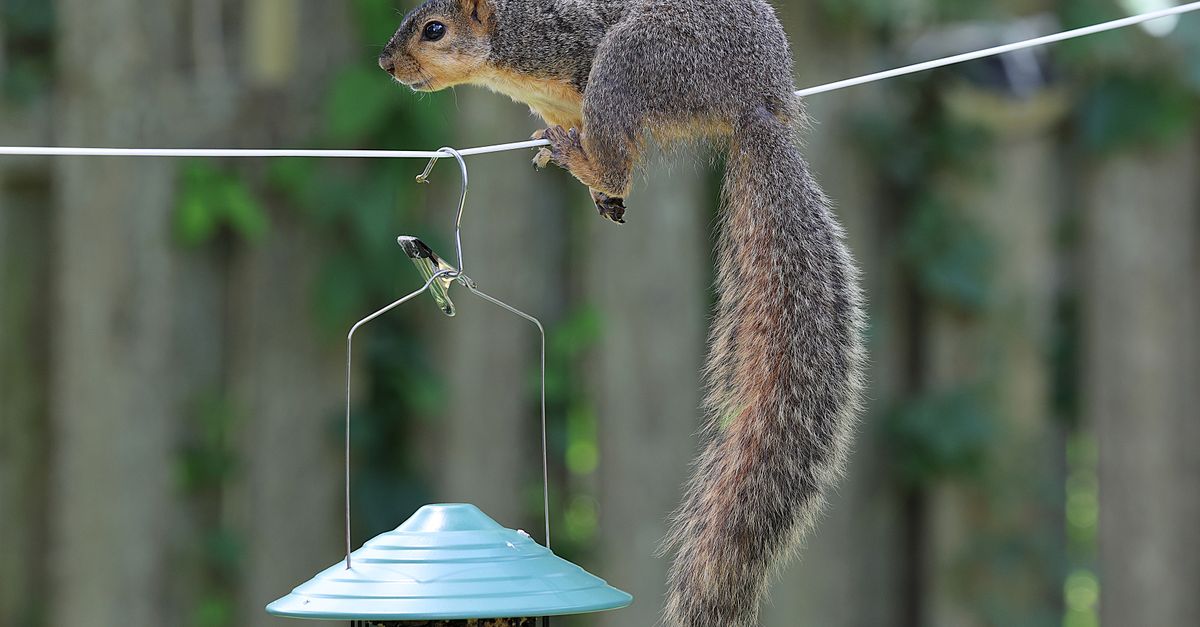
Every feeder on this list is squirrel-resistant, not squirrel-proof in the literal sense. The difference shows up when a squirrel can reach from a branch, roof, railing, or fence line, or when seed gets wet and clogs the mechanism.
The takeaway is simple: pick a design that fits your yard, then give it the space it needs. A great feeder under bad placement can perform worse than an average feeder hung in the open.
- Keep the feeder away from launch points such as branches, deck rails, fences, and rooflines.
- Use the maker's clearance guidance before deciding where to hang or pole-mount it.
- Choose a feeder with removable parts if you want easier cleaning and fewer clogs.
- Do not use sticky glues, poison baits, or other harmful pest controls.
- If a feeder sits near glass, add collision-prevention decals or move it to a safer spot.
How the three main feeder designs compare
Weight-activated tube feeders, cage-style feeders, and spring-port feeders all aim to solve the same problem in different ways. The best one for your yard depends on how aggressive your squirrels are, how many birds you want to feed at once, and how much maintenance you are willing to do.
If you want to identify which species are actually visiting, a smart camera feeder can help you match the feeder style to the birds you really get.
Weight-activated tube feeders
This is usually the closest thing to a true squirrel-proof feeder. The perches or ports close under a squirrel's weight while small birds can feed normally. Brome Squirrel Buster® Plus and the Brome Squirrel Solution200 are the standout current picks in this category.
- Best balance of squirrel resistance and small-bird access
- Usually works best in open air with clear space around it
- Often the easiest category to recommend as a first choice
Cage-style feeders
Cage-style feeders put a cage around the seed tube or ports. Birds can enter through openings while squirrels generally cannot get to the seed. They are familiar to many backyard birds and can work well in busy yards, but the cage can be bulkier and may need more room.
- Good if you want a familiar, enclosed look
- Can be effective for clinging songbirds
- May look larger or more noticeable in a small yard
Spring-port feeders
Roamwild's PestOff 2.0 uses a spring at each port and no user calibration, which is appealing if you want a simpler setup. It can be a smart pick for smaller spaces or for readers who do not want to fiddle with sensitivity settings.
- Simple setup with no calibration step
- Good for smaller feeding areas
- Only works as well as its ports stay clean and dry
How to place and maintain any squirrel-resistant feeder
Placement can make the difference between success and a wasted bag of seed. A feeder under a branch will lose no matter how good the mechanism is, and damp seed can gum up ports or encourage mold.
Think of the feeder as one part of a backyard system. Clean feeders, fresh water, and safe placement all help birds return, which is why a bird baths and birdhouses setup should be maintained just as carefully as the feeder.
- Mount or hang the feeder in open space with the recommended clearance.
- Use a pole and baffle if your yard layout makes that easier than hanging.
- Refresh seed before it clumps, smells stale, or gets wet.
- Clean the feeder regularly so ports and shrouds keep moving freely.
- Bring feeders in at night if bears, raccoons, or other larger animals are a problem.
- Do not disturb active nests; local laws protect most wild birds.
FAQ
What is the most squirrel-proof bird feeder?
For most backyards, a well-placed weight-activated feeder is the closest thing to truly squirrel-proof. The Brome Squirrel Buster® Plus is the strongest all-around pick here because it combines a proven shutoff mechanism with good small-bird access.
Are cage feeders better than weight-activated feeders?
Not always. Cage feeders can work very well, especially if your local birds are comfortable entering the cage, but weight-activated tube feeders usually give the best balance of squirrel resistance and easy access for smaller songbirds.
How much clearance does a squirrel-proof feeder need?
Follow the maker's instructions, but 18 inches of open space around the feeder is a common requirement on current models. Nearby branches, railings, fence tops, and roof edges can defeat even a good feeder.
What seed works best in a squirrel-resistant feeder?
Use the seed blend the feeder is designed for. Mixed seed, black-oil sunflower, chips, and safflower are common options, but keeping the seed dry matters more than the exact blend.
Will a squirrel-proof feeder stop raccoons or bears?
No. Squirrel-resistant feeders are not bear-proof or raccoon-proof, and larger animals can still damage them. If those animals visit your yard, bring feeders in at night and use a secure mounting setup.
Can a smart feeder help me choose the right design?
Yes. A smart camera feeder can show which birds are visiting, how crowded the feeder gets, and whether a tube, cage, or spring-port design fits your yard best.
Do I need to worry about nests near my feeder?
Yes. Do not disturb active nests, and remember that local laws protect most wild birds. If nesting birds are nearby, give them space and keep feeders clean and quiet.
The bottom line
For most backyards, the Brome Squirrel Buster® Plus is the best squirrel proof bird feeder because it combines strong squirrel resistance with small-bird access and easy maintenance. If you want mixed-seed flexibility or a cage-style look, the Perky-Pet® models are the next best places to start.
If your yard has tight space or you prefer a no-calibration design, Roamwild is worth a look. Whichever feeder you choose, give it enough clearance, keep seed dry, clean it regularly, and check the current price and availability from the maker before you buy.
Reader experiences
Own one of these? Your experience helps other readers decide.