8x42 vs 10x42 Binoculars: Which Should You Buy?
 By perchandseeds.com Editorial Team · Updated October 7, 2026
How we research: this guide is based on manufacturer specifications, published data and verified customer feedback. Products are not personally tested unless marked “Tested by us”. Our process.
We may earn a commission when you buy through links on this site, at no extra cost to you. As an Amazon Associate I earn from qualifying purchases.
If you bird with one pair and want the simplest answer, 8x42 is the safer default. It is easier to hold steady, easier to use in brush or feeders, and usually easier to live with on long walks.
10x42 is the better pick when distance matters more than ease of use. It makes far-off birds look larger, which helps for shorebirds, hawks, and open-country viewing, but the view is narrower and more shake-sensitive.
If you want a broader buying rundown beyond this size question, our birding binocular buying guide and best binoculars for bird watching roundup are the best next reads.
Not sure which one to get? Answer a few quick questions.
Which Birding Binocular Is Right for You?Quick picks
Comparison table
| Model | Best for | Main trade-off | Check price |
|---|---|---|---|
| Nikon Monarch M5 10x42 Binocular | Birders who want a current Nikon 10x42 with ED glass | More reach, but a narrower view and more shake sensitivity | Amazon |
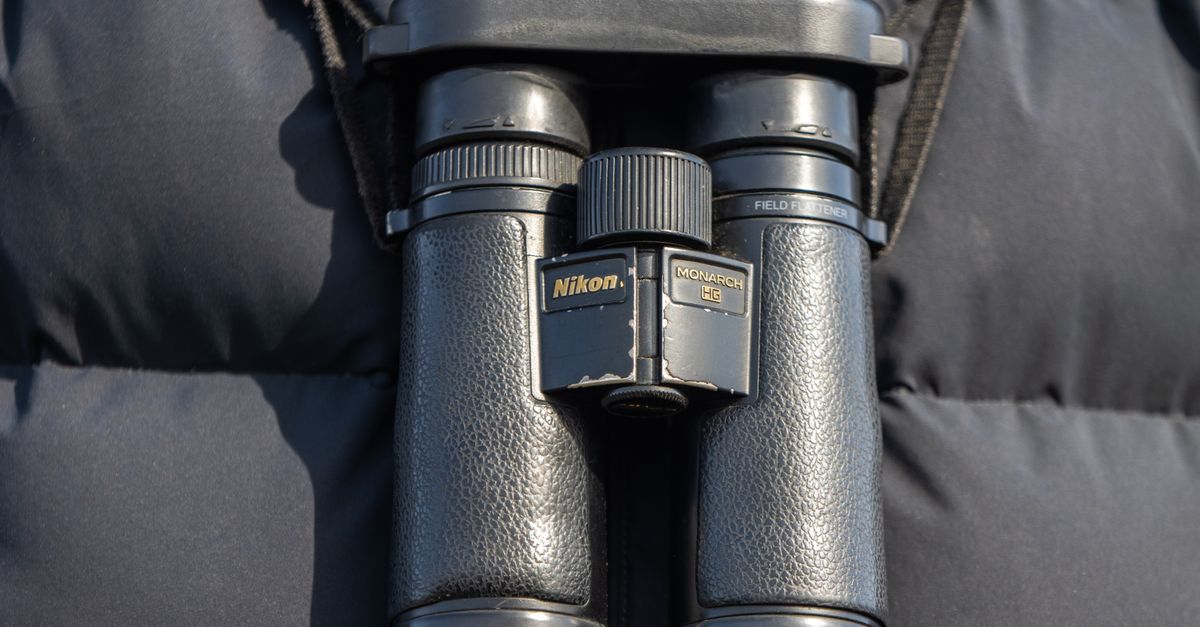
| Nikon MONARCH M7 10x42 | Distant birds, open-country viewing, shorebirds | More reach, but a narrower view and more shake sensitivity | Amazon |
Our picks in detail
Nikon Monarch M5 10x42 Binocular
Best for: Birders who want a current Nikon 10x42 with ED glass and a manageable build
The Nikon Monarch M5 10x42 Binocular gives you 10x magnification, a 42mm objective, ED glass, and waterproof/fogproof construction.
It has a 293 ft field of view at 1,000 yd, 8.2 ft close focus, and weighs 22.6 oz.
As a 10x42, it delivers more apparent reach than 8x for distant birds.
- Magnification / objective
- 10x42
- Field of view
- 293 ft at 1,000 yd
- Close focus
- 8.2 ft
- Weight
- 22.6 oz
- Optics
- ED glass
- Build
- Waterproof/fogproof
- Viewing behavior
- More reach, with the usual 10x trade-off in steadiness and view width
Pros
- More apparent reach on distant birds
- ED glass
- Waterproof/fogproof construction
- Relatively light at 22.6 oz
Cons
- 10x is harder to hold steady than 8x
- Field of view is narrower than 8x42
- Less relaxed for quick scanning in brush or around feeders
Nikon MONARCH M7 10x42
Best for: Birders who often watch birds at a distance and want more apparent reach
The Nikon MONARCH M7 10x42 is the better fit when your birding leans toward distance. It makes far-off birds look larger, which helps when you are trying to judge plumage, shape, or behavior across water or open ground.
The trade-off is the classic 10x experience: a narrower view and a steadier hand requirement. If you can hold it well, the extra reach is valuable.
The research notes identify this exact model with ASIN B09GVB27KV.
- Magnification / objective
- 10x42
- Eye relief
- 16.5 mm
- Weight
- 24 oz
- Close focus
- 8.2 ft
- Optics
- Roof prism with ED glass
- Build
- Waterproof/fogproof
- Viewing behavior
- More reach, but narrower than 8x42
Pros
- More apparent detail on distant subjects
- Useful for open-country and waterbird watching
- A strong fit if you are comfortable holding 10x steady
Cons
- Narrower field of view than 8x42
- More visible shake during handheld use
- Less forgiving eye relief than the 8x42 version
The short answer
If you want one pair for general birding, 8x42 is the safer choice. It is easier to hold steady, easier to aim at a moving bird, and usually less tiring over a full morning or afternoon.
Choose 10x42 if you already know that distance is your main problem. It helps more when birds are far away than when they are darting around in cover.
- Choose 8x42 for woods, backyards, feeders, and mixed habitat.
- Choose 8x42 if you wear glasses or want the least fatiguing handheld view.
- Choose 10x42 for shorebirds, hawks, ducks, and open landscapes.
- Choose 10x42 if you are comfortable with a narrower, shakier image.
- If you want one pair to do almost everything, start with 8x42.
What changes between 8x42 and 10x42
The first number is magnification. 8x makes the subject appear eight times closer, while 10x makes it appear ten times closer. The second number, 42, is the objective lens diameter in millimeters, which tells you the size of the front lenses, not the power.
So the real choice is not about which pair is universally better. It is about whether you value easier scanning and steadier handling more than you value a larger image of distant birds.
Field of view
A wider field of view makes it easier to find a bird and keep it centered. That matters a lot when the bird moves quickly, disappears into branches, or shows up in a mixed flock.
This is one reason 8x42 remains the most forgiving size for many birders.
- Better for warblers, sparrows, chickadees, and feeder traffic.
- Helps you re-find a bird after it hops or flies a short distance.
Steadiness
Ten-power binoculars magnify your hands' movement along with the bird. If your hands are steady or you can brace against a car, rail, or window ledge, 10x becomes easier to use.
If you notice shake while scanning, the jump from 8x to 10x can matter more than the spec sheet makes it seem.
- 10x rewards good holding technique.
- 8x is usually less fatiguing during long sessions.
Eye relief and comfort
Eye relief is the distance your eye can sit from the eyepiece and still see the full image. If you wear glasses, longer eye relief usually means a more comfortable full-field view.
Because eye relief varies by model, check the manufacturer’s published number before you buy.
- Check published eye relief before you buy.
- Twist-up eyecups should feel secure and repeatable.
Best choice by birding style
Think about where you actually spend time. The right answer in a wooded backyard is not always the right answer on a tidal flat.
If you mostly watch feeders, songbirds, or mixed backyard traffic, 8x42 is usually the happier choice. Pairing it with a productive setup from how to attract birds to your yard can be more useful than chasing extra magnification, and feeders or baths should be cleaned regularly to help reduce disease spread.
Backyard and feeders
Choose 8x42 if birds are close, active, and constantly moving. The wider view makes it easier to follow a cardinal from shrub to feeder or a warbler through a hedge.
- Best for feeders, hedgerows, and short-distance viewing.
- 8x42 usually feels easier for casual use around the house.
Woods and mixed habitat
Choose 8x42 if you bird in forests, parks, and brushy trails. In cluttered habitat, being able to find the bird fast is often more important than extra magnification.
10x42 can still work here, but the narrower view can make target acquisition slower.
- 8x42 helps you keep track of birds in branches.
- 10x42 is less forgiving when the bird moves suddenly.
Open country, water, and raptors
Choose 10x42 when birds are often far away and already easy to locate. Shorebirds, hawks, waterfowl, and birds across large marshes are classic 10x use cases.
If you like scanning from overlooks, beaches, or the car, the extra reach can be worth the trade-off.
- Best when distance is the main challenge.
- More useful for birds that stay in open view.
Long walks and all-day use
Choose 8x42 if you want the size that is easiest to live with for a full day. Less shake and a wider view usually mean less fatigue.
That is why many birders keep 8x42 as their everyday binocular and save 10x for specific outings.
- Better all-day comfort for many users.
- Often the safer one-pair choice for beginners.
How to decide in 30 seconds
If you are still torn, answer three questions. Do you want the easiest view to hold and scan? Pick 8x42. Do you regularly need more apparent reach? Pick 10x42. Do you wear glasses or bird for long stretches? That pushes you toward 8x42 unless the extra reach is essential.
If budget is part of the decision too, the same rule still holds: start with the size that matches your birding habits, then compare the optics that fit your wallet. Our best binoculars for bird watching on a budget guide is a good next stop.
- Mostly woods, feeders, or backyard birds: 8x42.
- Mostly open water, fields, and distant birds: 10x42.
- Glasses wearer who wants comfort: lean 8x42.
- Want one versatile pair: lean 8x42.
- Already know you like a larger image and can hold it steady: 10x42.
FAQ
Which is better for bird watching, 8x42 or 10x42?
For most birders, 8x42 is better because it is easier to hold steady and easier to use when birds move quickly. Choose 10x42 if you often watch birds at a distance and want more apparent reach.
Are 10x42 binoculars too shaky for handheld birding?
They can be for some people. Ten-power magnifies hand movement, so if you have less steady hands or you bird for long stretches, 8x42 is usually more comfortable. Good posture and bracing help, but they do not change the basic trade-off.
What does the 42 mean in 8x42?
The 42 is the objective lens diameter in millimeters. It tells you the size of the front lenses, not the magnification.
Are 8x42 binoculars better for glasses wearers?
Often yes. In comparable models, 8x42 usually feels more forgiving at the eyepiece because it often has more usable eye relief and a wider, easier-to-see view.
Do I need 10x42 for hawks and shorebirds?
Not always, but it can be a smart choice if you spend a lot of time in open country or around water. If you want the easiest all-around view, 8x42 still works well for many birders.
Can I get close to nests or roosts for a better view?
No. Watch from a respectful distance and never disturb nests, flush parents off eggs or chicks, or handle wild birds. Local and federal laws protect most wild birds, and binoculars should be used for observation only.
The bottom line
If you want the most forgiving all-around birding binocular size, choose 8x42. If your birding is mostly open water, fields, or other long-distance viewing, 10x42 can be worth the trade-off.
For a broader model-by-model overview, see our birding binoculars complete buying guide.
Reader experiences
Own one of these? Your experience helps other readers decide.